Micro.bloggers: I’m interested in turning the link log into a micro.blog plug-in, but I don’t have the skill or the will to make it happen. Where should I begin?
Micro.bloggers: I’m interested in turning the link log into a micro.blog plug-in, but I don’t have the skill or the will to make it happen. Where should I begin?
When accidental engagement counts the same as intentional engagement.
Deep dive: What are platforms, and why do they have so much power?
Question for parents: How are you teaching your teens to stay safe and think about safety and security while they surf, shop, chat and learn on their digital apps and devices? Are you sharing books, articles and videos with one another? If so, which ones? I’m asking for a friend; the friend is me.
Question for micro.bloggers: Can you separate keywords by comma in this category filter field, or is it one word per filter? 
A linklog is a dated list of outbound links, maybe a tag, and a note about why it’s worthwhile. But that little note does two things at once, and together they make for a better web.
First, it’s a way of organizing the web. The web doesn’t sort itself, so finding good information depends on someone curating and tracking interesting content, preferably on the open, free internet. It acts as a customizable bookmark library: newest at the top, tags to group items, and a line explaining why the link was worthwhile. This is similar to what del.icio.us did, where people grouped and tagged links, creating a rough filing system.
Second, it’s a social act. An outbound link points to someone else’s work, so a linklog is essentially a renewable engine for sending traffic to other people and places. It stays renewable because the content is easy to sort and remix: a URL’s relevance no longer depends on where an algorithm or activity feed happens to place it, so older links can keep resurfacing instead of scrolling out of reach. That’s the precise opposite of what big platforms design for audiences; platforms such as Twitter, Instagram and Facebook quietly bury posts with outbound links to keep your attention (and dollars) on their site and with their advertising customers, losing relevance after one interaction. A linklog explores the opposing dynamic: it willingly hands your audience and attention away while crediting your forebears, comrades, mentors and co-conspirators. It turns the rough digital filing system into a “folksonomy,” if you will.
Compare these dynamics to an algorithmic feed on a platform. An algo also sorts the flood of content, but computer magic does the sorting, and someone else monetizes your attention and relationships and hoards your data. “Engagement” for these companies is primarily a measure of how long you stay on their platform with their content. The goal is to keep you scrolling and the ad revenue rolling. But over here on the indie internet, our goal is to build human communities online and connect people to quality information, tools, ideas and processes.
Back in the day, we had blogrolls, and blogrolls came with a lot of politics around representation and belonging, and some of those choices had real-world impacts. Who you listed in your sidebar was a public statement about your community and your allegiances; however, though smaller blogs linked to bigger ones, the big blogs rarely returned the attention. That contentious dynamic faded as social platforms became the main sites for online interaction, and the follow list, or the Twitter list, took over the blogroll’s old job of reinforcing networked hierarchies of writers and audiences. Because a blogroll is a static list of people, it hardens into a status game and is kind of stale the moment someone stops babysitting it; meanwhile, a linklog points at individual pieces of writing one at a time, so it stays current and rewards the work rather than the social and professional standing of the writer.
In this sense, a linklog is an easy way to be an opinionated curator and a decent neighbor at once, by hosting and sharing with thoughtfulness and deliberation. Out here, my data is also likely being scraped, but I have far more control over what data is findable, shared, and shareable, and over what is investigable and degradable over time.
Community Notes was meant to democratize moderation power (and spare platforms the burden of thinking through moderation). Instead, a new paper shows that 20% of users cast 80% of ratings, and removing just ten active note writers from the pool changes what happens to nearly 5,000 community notes.
Gruber argues that AI text watermarking likely degrades prose quality and, even if it doesn’t, remains objectionable because it operates as an embargoed, unverifiable tag or signal controlled by providers like Anthropic and Google.
I spent a little time with the blog last night and pulled together two new site features using Claude Cowork. The last time I experimented significantly with Claude like this was to use Claude chat to build the link log from scratch, walking it through my thinking in plain language, then copying and pasting its suggestions into the backend of the site and hitting publish. This time I used Cowork, the tool that runs in the browser, and it clicked through the screens itself, fully taking on the execution of tasks. I have some coding skills, but not the kind these changes required. If I were taking this on, I would need YouTube, Hugo for Dummies, and my own personal IT guy, and still probably couldn’t pull it together.
Last night I asked a few things of Claude: I asked Claude Cowork to get into the backend of the micro.blog site and change my theme to link each line in the linklog back to my original post. The date field in the right column now links back to the original post for each link logged. No problem, easy request with easy execution. I made the request, confirmed the plan, and went about my business while Claude made the edits.
I also asked it to analyze my post content and suggest category tags for groups of content, then to label that content correctly in the backend. Claude reviewed about 500 posts and suggested I add a few new categories to my blog: AI in Practice, Books & Reading and Writing & Language. Then I set up some auto-filters to run at publish time to automatically categorize posts based on keywords moving forward.
Finally, I manually added the archive page, which lets you sort posts by category or year. This means I now have a functional archive here. Enjoy my anodyne thoughts, dear reader.
Adjacent to my day job, I’ve been toying with Claude Pro now for about a year; in my experience, it has improved significantly within the last six months. It’s not perfect: my requested edits were completed, but it also changed the CSS on the linklog so some of the text is too light to read, which I didn’t ask for and don’t want. But it has arguably extended my ability to execute on work that requires skills I don’t otherwise have (such as design and coding). What I do bring to the table is an expansive practical background in publishing and production, and all the language to describe it.
“When you gaze long enough into Instagram, Instagram gazes back into you.”
Claude is launching an AI watermark, one that users can’t opt out of (but can easily outsmart). As internet god Notopoulos wrote, “Claude’s watermarking poses the question: Are you willing to proudly own that you write with AI?” More: What is an AI watermark and how do they work?
The knitting community is one of the great deliberative communities of the internet, and as they’ll happily tell you, knitting and fiber arts are closely tied to industrial and computing history. It’s really hard to pull one over on knitters online, because they have a deep and different relationship to the technical side of their hobby and all of the political and tech history behind it, and especially how it relates to computer engineering. I was thinking about that dynamic while reading about the latest fracas around YouTuber Hank Green, who is taking time away from public life after being called out by his audience, when his AI use was perceived as being in contradiction with his public persona. If you want to go down the rabbit hole on this, here’s a good video summary.
Ultimately viewers are reacting negatively to Green’s admission of using AI to quickly aggregate research to drive his content creation, suggesting that he lost his own creative discretion amid a growing demand for online content. But in the meantime, his technical inaccuracies were paired with completely avoidable gender bias alongside the AI use, which drew additional scrutiny from technical experts. It wasn’t his first go-round with the knitting community, it turns out. Was the bias Green’s or facilitated by his use of the tools? Debate ensues.
Winer on the purpose of web standards: “I find that most standards that come out of the standards bodies aren’t developed by implementors or with them in mind. They avoid trying to solve any specific problem, rather focusing on the elegance and flexibility of the format. This makes interop much less likely. I saw the differences several times as the web standards were growing up.”
I found this American Affairs article on the insidiousness of ad tech quite relevant. It focuses on foreign propagandists’ exploitation of social media, but it’s just as instructive for thinking about ad tech as tech, channel and product, and its entwinement with social media as infrastructure.
Garbage Day uses Jimothy to trace how virality works on the internet of 2026. Related: this story on how the algorithm has prevented us from producing a single “song of the summer.”
A colleague hosted a nice discussion of the work of David Dylan Thomas, who advocates for using human-centered design concepts to bring humanity back to tech. New and novel approaches abound, especially on whether and how to let engagement metrics drive decisions on design teams.
This is a pretty good Tiktok breaking down the historical, cultural and religious meanings invoked in the “computah” memes. An important rule of the internet: the best memes are intertextual.
Major changes coming to Google Search. Question: What search engines do we like in 2026?
Stanford’s Clayman Institute ran a virtual panel this morning called “Gender, Power, and Artificial Intelligence,” with Safiya Noble (UCLA), Catherine D’Ignazio (MIT), Angèle Christin (Stanford), and moderator Genevieve Smith, a Clayman Institute Postdoctoral Fellow. The panel applied principles from feminist tech studies to the current moment, and covered how gender norms get encoded in data and reproduced by AI systems, and discussed whether the technology has real capacity for equitable design and implementation at scale.
Noble’s argument throughout is that the governance conversation has gotten too high-level and universalizing while the actual outputs of these systems have profound day-to-day consequences for specific people today. She named the role of AI in the recent gerrymandering of Louisiana and Indiana as examples, and called for tripling down on long-term social science research about AI’s impacts. She also pointed out that philanthropy is retreating from feminist academic and organizational work because that work originates from the same dynamics that critique philanthropy itself, precisely at a point when this research is sorely needed. A lot of money is moving in AI, and very little of it is funding the people best positioned to study how it impacts everyone downstream.
D’Ignazio was asked directly whether feminist generative AI at scale is possible. Her answer was no, with caveats, given who owns the technology today and the current emphasis on profit motive. She suggested it is more important to consider how to organize around our relationship to technology, and how we might approach questions of profit and ownership, policy and decision-making, and data and tech governance.
She provided an example of a reasonable use case by walking us through a project from her Data + Feminism Lab. The example is documented at length in her recent book “Counting Feminicide: Data Feminism in Action,” where her team partnered with activists who scour news reports to document the gender-related killing of women and girls, including cisgender and transgender women. The lab built a very lightweight AI-based approach that streamlines the scanning and identification of news stories as possible cases to include in their project, supercharging their work (note: very similar to how the NYT uses AI to analyze data for reporting). In this example, the AI’s job is task-scoped, democratically co-determined with the people who use it, and small. Smith picked this up: there is an idea baked into the current LLM moment that AI must scale to make it marketable, and the alternative is using purpose-built models that are right-sized against a body of work.
Christin spoke at length about how embodiment is one of the primary focuses of feminist theory, and how AI perpetuates the “disembodied” illusion of technology, and how this dynamic shows up in everything from the marketing to UX to user comprehension. This spoke to my thoughts on how the single-interface design of LLM chat reproduces Haraway’s “god trick,” knowledge that presents as universal while concealing the specific and situated position it comes from.
The parallel I kept returning to, listening to this, is one I think about often with my own cohort of early bloggers, women who grew up alongside the rise of the internet — and then the rise of ad tech. The internet of the late 1990s and early 2000s was being shaped by several camps: writers, students, information architects, and user-centric researchers who saw it as an information access network and a space of possibility; entrepreneurs and opportunists who saw it as a channel for marketing, monetization and extraction; and a smaller boycott camp that wanted to limit and refuse the whole personal computing and digital revolution altogether.
It was generally considered weird to be a girl on a computer or a woman on the internet — so weird that many of our peers didn’t recognize us at all — and we were there anyway, making stuff, witnessing, learning, advocating, producing, influencing. So when I watch some of my old peers, many of whom are professional writers and academics today, treat LLMs as a question of refusal rather than a condition to engage with critically, I worry we are abdicating a responsibility at precisely the moment when our technical and rhetorical expertise applies. Their refusal has good logic: user-centric researchers and communities engaged extensively with the early internet and the extractive camp won anyway, so why expect a different outcome here?
But Noble’s work on algorithmic bias attributes that failure not to engagement, but to the institutional and financial disadvantages that user-centric approaches operated under relative to gargantuan commercial interests. David and Goliath. That gap does not close through abstention. Understanding the trade-offs around tech, producing knowledge and analysis that does not depend on investors and marketers to frame the platform and the questions, requires presence. Refusal cedes so much ground.
Overall, the recommendations from the panel were practical. Noble called for people with capital (and the political will to spend it) to consider how to put money toward socially responsible research and development. D’Ignazio called for alternative funding infrastructure outside of venture capital logic, and pointed at European digital sovereignty models as worthy of consideration here. She also gestured at the popular AI Skeptics reading group as one current example of mad-and-commiserating-as-organizing that is creating safe psychological space for people to talk about AI and its tradeoffs. Christin’s recommendation was community organizing, on the grounds that LLMs are unpopular with a lot of people who feel there is no space to say so, and that finding those spaces is itself worthy because it provides shared language and awareness of others’ knowledge and experiences.
Personally, it was refreshing to hear reflections on the work (and the feelings) of being inside institutions that are being reshaped by AI, and being responsible for some of how that reshaping gets communicated and absorbed. I’m thinking about the incredible value of interdisciplinary governance, and how the commitment to governance is a specific position, and all the margins to consider.
Further reading:
Catherine D’Ignazio and Lauren Klein, Data Feminism. The foundational text on applying intersectional feminist thinking to data science practice.
Catherine D’Ignazio, Counting Feminicide: Data Feminism in Action. Extended case study of the grassroots data activism project D’Ignazio described on the panel.
D’Ignazio et al., “Feminicide and Counterdata Production.” Research paper on the counterdata methodology behind the femicide tracking project.
D’Ignazio et al., “Data Feminism for AI.” Conference paper extending the data feminism framework to questions specific to AI systems.
Safiya Noble, Algorithms of Oppression. Noble’s study of how commercial search engines reinforce racism and sexism through their ranking systems.
Donna Haraway, “Situated Knowledges: The Science Question in Feminism and the Privilege of Partial Perspective” (1988). The original essay where Haraway introduces the god trick and the case for situated, embodied knowledge against the view from nowhere.
“Two things can be independently true about social media. First, there is no evidence that using these platforms is rewiring children’s brains or driving an epidemic of mental illness. Second, considerable reforms to these platforms are required, given how much time young people spend on them.”
For those who love to post, a guide to the Internet of the future.
I’m seeing grunge icons L7 in concert with Amyl and the Sniffers this summer and have been reading a lot about the ’90s indie rock era in the meantime. One frame I keep encountering positions grunge as regional punk musicians navigating a global, corporate pop mainstream – awkward, crass and vulgar, but in the big leagues all the same. Reading the Auf der Maur bio reminded me that a lot of the punk scene was steeped in ideas about social roles and archetypes and oriented around upending them – or at least giving them a healthy challenge. This subculture was also populated by poets and artists in the classical sense. The retro polish around ’90s pop culture has flattened that texture, but it was genuinely a thing.
The era also introduced the woman rock star, introducing women who wrote and performed with full creative authority, not just as muses, groupies or singers. The reception from fans and critics was mixed, and the discourse around Courtney Love in particular was gross and volatile. Most of the positions she was vilified for read as entirely unremarkable today. I was a teenager during all of this, too young to meaningfully participate, but the aesthetic dominated my early adolescence. At the time I loved Tori Amos and PJ Harvey like kids now love Chappell Roan. What I forgot over time is how literary the era was, and how romantic, both in the literary sense and in relation to the New Romantics of the 1980’s. Big culture lessons for a starry-eyed teenager.
L7’s music is not that deep – it’s metal for meatheads, by design – but their politics and presence were. While poking around, I found that L7 was one of four bands featured in the 1995 documentary film Not Bad For a Girl, which was co-produced by Love and Kurt Cobain. The film focused on several all-female indie punk bands and won Best Documentary at the New York Underground Film Festival in 1996. I’ve never heard of it before now. It got middling reviews from critics then, and it’s not available streaming in full in English, unless you’re viewing it here at this dubious Google Drive link – which I will do and report back.
Poell argues AI is entangled with platform capitalism through shared infrastructure, reinforcing concentration of the market. The hype obscures local realities of adoption, putting public alternatives in the position of proving their existence alongside advocating for their place in the market.
Pulling from some old communication theory while I am thinking about blogging and the indie web, and especially thinking about Dallas Smythe, who argues that mass media doesn’t produce content but audiences, packaged and sold to advertisers. On social media, users aren’t just the audience being sold, they’re also a labor force co-producing the content that attracts more audience.
Looking back at the feminist blogging era with the benefit of my current experience, I’d argue that what made Feministe different from our peer blogs was the commitment to convening the audience and sharing the platform without packaging it up for or selling to advertisers. That was largely my boundary – with as much market space as it commanded for the time, it was never monetized at scale, though individual contributors were free to use it as they wanted to build their audiences. We eventually committed to a small advertising carousel to cover hosting costs.
I recall someone balking at me for refusing to broadly monetize when I spoke at Blogher in 2005, but it was a hard line, for better or worse.
This post and the accompanying graphs have been a trending topic on social all weekend, particularly on Twitter/X, which is negatively implicated in the findings. In short, social media looks weirder than ever.
Innovations in scamming: Folks are predicting that AI will supercharge scams alongside any technical and administrative innovation. Here’s one example of an unethical use of AI, where an internet-based GLP-1 hub used AI to generate fake product images and before and after photos of smiling patients.
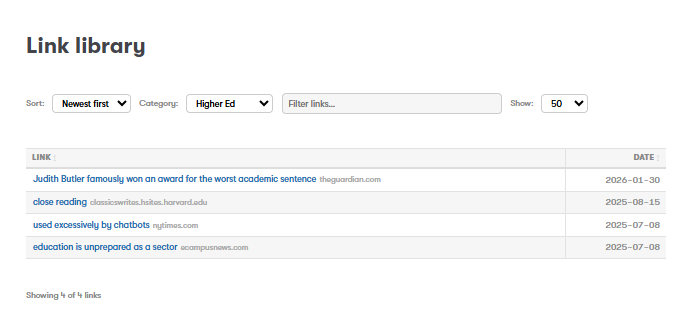
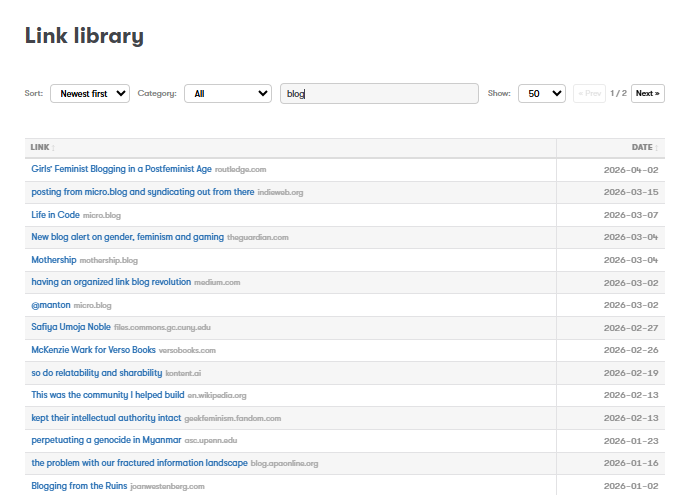
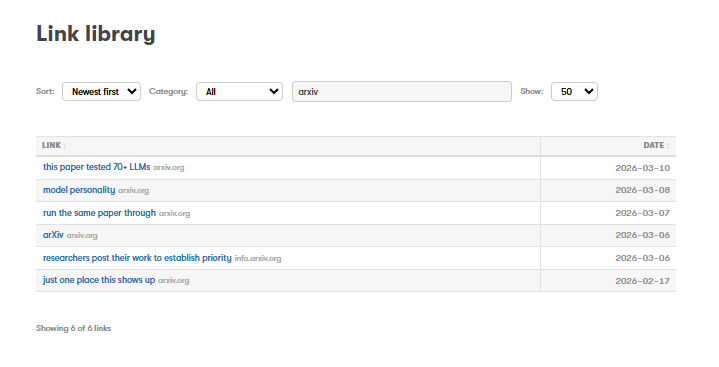
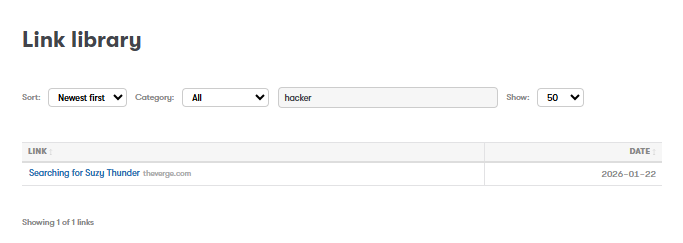
Testing a new feature I created using a mix of open source code and Claude, hoping I didn’t break my own site. I pulled together a dynamic link library using a Hugo partial and some shortcode that automatically catalogs all of my outbound links into sortable lists.
From 2024: Siva Vaidhyanathan, Professor of Media Studies and director of the Center for Media and Citizenship at the University of Virginia, on the durable limits of Haidt’s “The Anxious Generation.”
From 2024, Anil Dash on why everyone needs to rethink Substack.
A roundup of news stories on Meta and Google’s losses in court this week, where their social media business practices were found harmful to children’s mental health and in violation of consumer protection law.