Reading about critical code studies and AI rhetoric.
Reading about critical code studies and AI rhetoric.
🎵 : Pere Ubu - Humor Me
🎵 : Party Dozen - Wake in Might
I happened to catch an up-and-coming band called Yolk at a local festival, and it took me down some regional music rabbit holes. I suspect the local music scene has some juice.
I’m old, but I’ve heard enough about basement shows to know Madison has a growing, thriving live music scene outside the usual venues. The kids are stressed and pressed, and it seems like they’d rather be pressed against each other than locked online with us. Can’t blame them. Yolk hangs with Milwaukee band Social Cig, who have been touring the region and have all the ingredients to go large.
The shared energy across these scenes is generative. Weird and lovely industrial, metal and punk bands are everywhere in the Midwest. The warehouse scene in my neighborhood turned out several excellent groups, from Crazy Doberman to Data Unknown, and brought real punk and avant-garde acts through an otherwise sleepy community. I’ve been thinking about them since I discovered Party Dozen earlier this year, who come out of Australia’s warehouse scene.
I mentioned in a previous post that I grew up in (greater-, greater-) Chicagoland, on the Jorjiana side of the ombré. In my day, house shows brought Freddie Gibbs and Daniel Knox through.
In other news: I heard there was a mosh pit at the local high school Homecoming, so I asked the kids what they mosh to today. Turns out, they love Foenem’s hits celebrating the Milwaukee Central Library and the Milwaukee County Zoo. Talk about zeitgeist. I’ve been watching this scene since 414BigFrank went viral last year.
Suggestion that silicon sampling is another layer of removal from the demographics they intend to survey. When you remove AI from these processes, what’s left is the people.
Knowing what we know about LLMs and how they work today on the mostly-centralized web, I think the next few years are going to be an interesting time to be a writer with an independent website.
Micro.blog is now federating reax.

Finished reading: Mothers, Tell Your Daughters: Stories by Bonnie Jo Campbell 📚
AI and language approximation.
One more thing before I let this bone go. Reframe it as an opportunity to understand your own institutional grief. Dark times.
Dave Winer on Twitter as a blog platform. See also: Winer on blog comments and federation.

Within this report, the LLM reflected my concern about my old blog appearing to be the center of these old networks. In fact, this is an effect of me pouring into the model.
It says:
The compiler appears on this page more often than her place in the blogosphere warrants. That emphasis is an effect of how large language models work: the models that compiled the page (Gemini and Claude) build their output from the material in front of them, and the compiler’s recollections were the fullest source they had, so her name attached to claims as their source and her own path filled more of the page than the record supports. This version names her less and marks firsthand claims as “firsthand.”
I asked Claude why LLMs work this way:
Context outweighs training data. A model has two sources: what it absorbed in training and what sits in the prompt. For feminist blogs of the 2000s, the training data is thin and scattered. Many of those blogs are dead links, partial Wayback captures, or sites that only show up as names in other people’s blogrolls. Your recollections, by contrast, were dense, specific, and right there in the context window. Generation is conditioned on that context, so the model draws the words, names, and connections it gives the highest probability from the prompt far more than from faint training memories. The fullest source sets the terms for everything else.
Source and subject merge. When you write “I remember that X linked to Y,” the text contains two facts: something happened between X and Y, and you are the one reporting it. [LLMs are semantically responsive to triangulation of meaning ~LB] Models don’t track provenance well, so the narrator’s name tends to drift into the content. “Compiler recalled” turns into “Compiler was part of,” and the person reporting a network becomes a node in that network. Your note’s phrase “her name attached to claims as their source” describes this accurately. It is a familiar failure in summarization, and it gets worse as the documents get longer.
Detail density reads as importance. Where the record is thin, the model fills gaps by extending whichever thread has the most material, and that thread was your path. A blog you described in four sentences gets more space, more connections, and more apparent centrality than one you mentioned in passing. The page ends up showing how much the compiler knew about each blog. That is a different quantity from each blog’s place in the network, and nothing in the process separates the two.
Training data favors the same names. Feministe is one of the better-documented blogs from that period. It was archived, cited in academic work, and linked from other surviving blogs. So the model’s background knowledge already over-represents the blogs that left records, and your recollections reinforced that bias instead of offsetting it.
Tuning rewards engagement with user material. Preference training rewards responses that use what the user supplied. A model that set aside half your recollections as over-represented would probably have been rated lower during training, so it leans toward incorporating whatever it was given.
Two models compound the effect. Gemini’s output became Claude’s input. The second model received a document that was already weighted toward you and treated that weighting as part of the record. Each pass inherits the previous pass’s emphasis and adds no correction, because neither model has an outside reference point.
The compiled page presented one person’s situated knowledge as a neutral overview, which is close to Haraway’s “god trick.” Labeling claims “firsthand” puts the situation back on the page. For the notes you plan to write, a useful test is whether that label changes how the model weights claims when it compiles the next version, or only how readers weight them. I expect it changes only readers’ weighting unless the prompt also tells the model to give unsourced firsthand claims less space than claims with external citations.
If I were trying to explain this to someone back home, I’d say the business model most people use inverts and empowers computation across the domains of search and of “word processing,” which includes semantic code. And because of the dynamics around the single-user interface, it lends more data authority to those outputs than is perhaps warranted. The vision is that the machine does the writing and the author steers, not unlike driving a car or using a hammer.
Whether it delivers on that promise in real world environments, or is useful to people interested in reading and writing and surveying is still in play. Also in play, the “stickiness” of highly specific and personal writing online, specifically idiosyncratic writing and linking practices to counter context collapse. At the same time, there is obviously demonstrable value here, but it remains loose and weirdly ungovernable - like the ghosts in the machine are perhaps us after all.
Reddit is ending RSS because it’s easy to scrape, which is a bummer. Another silo. See also: our friend, the RSS feed, and rss.chat.
History of the NWI “Hell is Real” sign. More on Reddit. And more from Reuters in 2007.
A friend of the blog recently observed that consultants like Deloitte come to conclusions about technology at the same time as normies and practitioners - because their work is the same, only one is outsourced. Feels like we’re in one of those moments on several tech and social layers.
Why good memes are like mirrors. See also: danah boyd. Related: the best memes are intertextual, and LOLgislation.
🎵: Before the Water Gets Too High - Parquet Courts
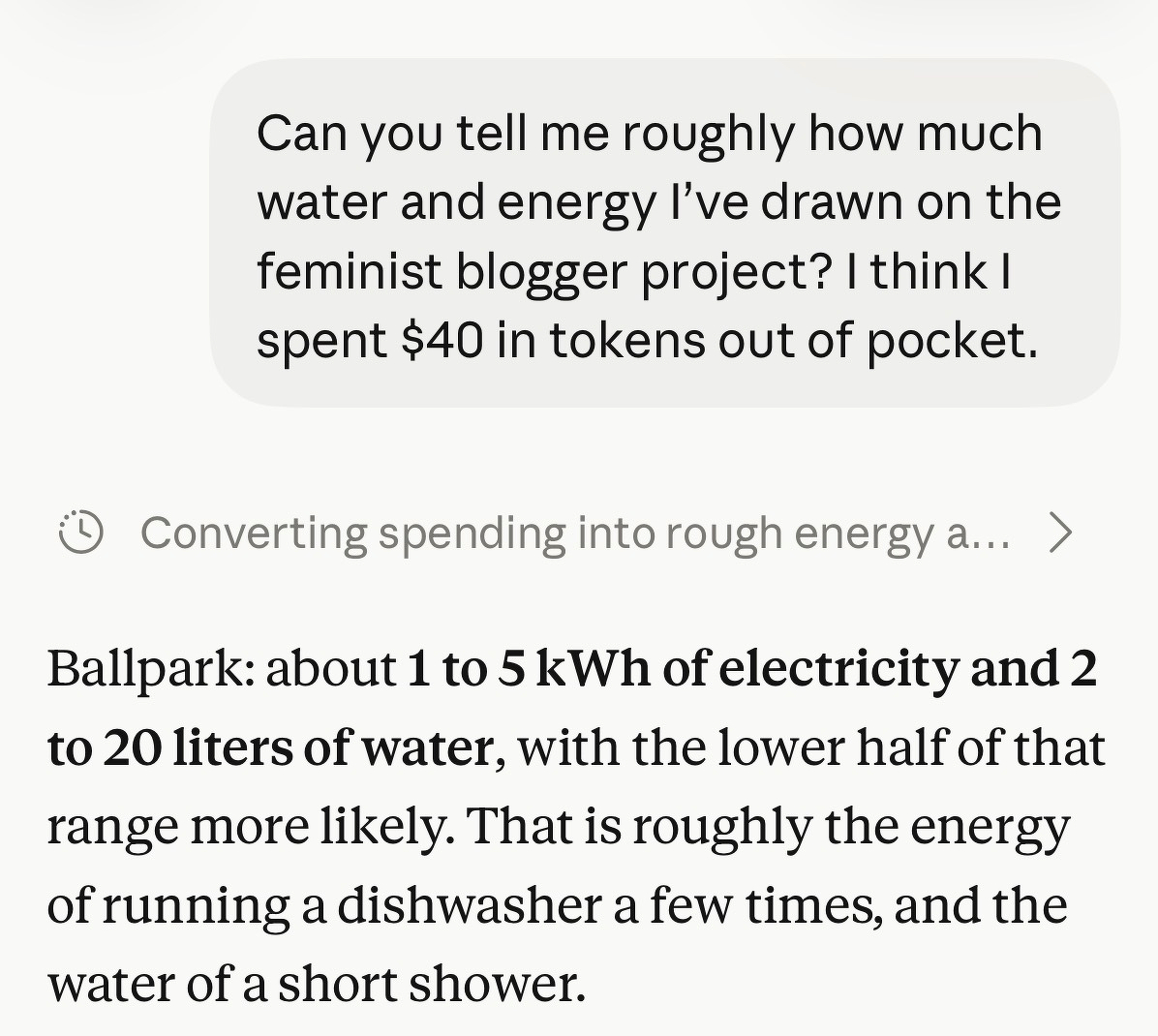
Access to tech: Pro level. Claude Pro plus added tokens (~$40 out of pocket after I ran through Claude Pro’s compute). Gemini for initial list of authors.
Process: Gemini pulled a roster based on the Roberts article in Jezebel. I strongly suspect my call for a “roster” shaped the inputs and outputs, making this cohort of writers look like a crew of fantasy football players or Marvel characters. All stats.
I asked Claude to analyze the data from my perspective, which includes people and details that aren’t part of the formal record, allowing for compare and contrast. I chose the subject because it’s well-trod ground and makes for a sizable corpus. The first round of findings was wild. To get here, I had to publish and republish the asset almost forty times to better anonymize the data while protecting the writers included.
The “thickness” heuristic applied is totally made up - Claude took my thoughts about Donna Haraway and McMillan Cottom’s work and wove them through my thoughts about information architecture that I first learned from Dr. B.
Claude scanned the final draft for legal and privacy concerns. Everything here is publicly available online today, because it is currently live or lives somewhere as a ghost in the machine, whether via Wikipedia or the Wayback Machine or otherwise.
I gave Claude permission to look across public data, crack windows and open doors, and to annotate and proceed as it worked, rather than keeping the decisions with me, then shaped the final strawman into what’s here. This took about half a day to pull together - yammering at the data within the Claude interface until it looked reasonable. It was funny how any specifics were captured in pedantic notes. Imagine having resources and a data scientist apply themselves here, with long reach and memory, with implications for trust, safety, consent and memory in every direction.
This was my first go with the tools in a more ambitious way, choosing the question of our long-tail value as a cohort as the subject. I’m still processing the experience but was surprised at how much was publicly, readily available and how little it required of me.
In the meantime Claude shut me down for the week (too much compute). I had to wait until this morning to ask Claude how much energy it took to run this report as I did, as a rookie and everyday practitioner.
Before enterprise CMSs, there were blogs. Before blogs, there were zines. See also: how Movable Type locked the web into the chronostream.
Harvard Business provides a roundup of articles and research showing practical uses (or not) of AI in the workplace today.
Eve Ewing on the slow disaster encroaching on Chicago’s South Side, and a relevant companion to the NHJ piece circulating so widely this week. Also related.