Timothy Chester offers some thoughts on the place of AI-assisted software development in a modern research university, and suggests that just because you can doesn’t necessarily mean you should.
Timothy Chester offers some thoughts on the place of AI-assisted software development in a modern research university, and suggests that just because you can doesn’t necessarily mean you should.
Out: Twitter on a vape. In: AI-powered crypto vape. Is this real? Who can tell anymore. See also: the first Twitter on a vape.
Maris Kreizman on AI pressures building in the publishing industry, particularly how it impacts writers and editors: “It’s not an ideal environment for productivity, let alone for making art.”
I’m following a guy in TX who is using AI to write and illustrate children’s books whole cloth, then self-publishes using Amazon, and getting recognition in his region as a laudable children’s author. The books are categorically not good. It’s like people are rewarding his content strategy.
Tom’s Hardware on Mythos and marketing hype. Additional commentary from Michael Corn, asking whether Mythos coverage reinforces or establishes perceptions about cybersecurity.
I once worked in a role where I keyed million dollar manufacturing orders into SAP, information that directly fed into factory specs for a manufacturing facility based in another country. Our regional office fed into a massive, global electrical engineering firm that ran on small margins (electricity delivery is a well-trod market), so our ability to deliver accurate orders on time was a differentiator in a field that is otherwise easily interrupted by chip shortages and logistics chains.
It was a big job. I learned a ton about electrical engineering, manufacturing and global logistics from a particular vantage point in North America. Our headquarters were based in Sweden, with locations around the world to support the electrical grid(s), covering both hardware and software solutions. My colleagues and I worked in positions that sat somewhere between B2B customer service, inside sales and data entry, and were expected to maintain a 99.8% accuracy rate because a single fat finger error would cascade across myriad systems, impacting real-world operations to the tune of hundreds of thousands of dollars per error.
Once (and only once), I fat-fingered a serial number during data entry which ruined an entire shipment of widgets. In response, the factory in Mexico sent the incorrect order of widgets, about five pallets, to my location in the United States so I could correct the order by hand. One by one, I had to physically remove each widget from a pallet, then from its individual shipping container, make a correction on the widget itself, and repackage each one, signing my name on each unit to ensure it was corrected by an accountable employee. I can’t recall why the issue couldn’t have been corrected on the factory floor, but it wasn’t on the menu. It was going to stay my problem.
This was the one and only factory error I made in about five years of tenure, precisely because it was so painful to correct it. The process was a little embarrassing but nobody made it especially so. Instead my coworkers up and down the org chart relayed a simple expectation: the desk workers need to pay attention to the details because the alternative is too costly. A few old-timers made sure to razz me about it in good humor, but ultimately the error was mine and the fix was mine, and the experience stuck because the whole chain of responsibility understood the stakes and reinforced the consequences. They also trusted me to stick around and continue to do my best.
During my annual review that year, I was dinged for only having a 98% accuracy rate, and I knew why that was a fair assessment.
I thought about this when I read today’s NYT piece on whether 90% accuracy is good enough for LLMs.
Related-ish: The important legacy of the Sarbanes-Oxley Act.
Poell argues AI is entangled with platform capitalism through shared infrastructure, reinforcing concentration of the market. The hype obscures local realities of adoption, putting public alternatives in the position of proving their existence alongside advocating for their place in the market.
Pulling from some old communication theory while I am thinking about blogging and the indie web, and especially thinking about Dallas Smythe, who argues that mass media doesn’t produce content but audiences, packaged and sold to advertisers. On social media, users aren’t just the audience being sold, they’re also a labor force co-producing the content that attracts more audience.
Looking back at the feminist blogging era with the benefit of my current experience, I’d argue that what made Feministe different from our peer blogs was the commitment to convening the audience and sharing the platform without packaging it up for or selling to advertisers. That was largely my boundary – with as much market space as it commanded for the time, it was never monetized at scale, though individual contributors were free to use it as they wanted to build their audiences. We eventually committed to a small advertising carousel to cover hosting costs.
I recall someone balking at me for refusing to broadly monetize when I spoke at Blogher in 2005, but it was a hard line, for better or worse.
Seeing a lot of discussion about trade-offs related to vibe-coding.
Silicon sampling is the practice of using LLMs to run surveys without talking to any people at all.
Innovations in scamming: Folks are predicting that AI will supercharge scams alongside any technical and administrative innovation. Here’s one example of an unethical use of AI, where an internet-based GLP-1 hub used AI to generate fake product images and before and after photos of smiling patients.
Enh: Describing the development of agentic AI as a natural evolutionary transition naturalizes specific design choices made by specific people at Google et al. It makes it harder, not easier, to find out why this path? Who decided? What was not built?
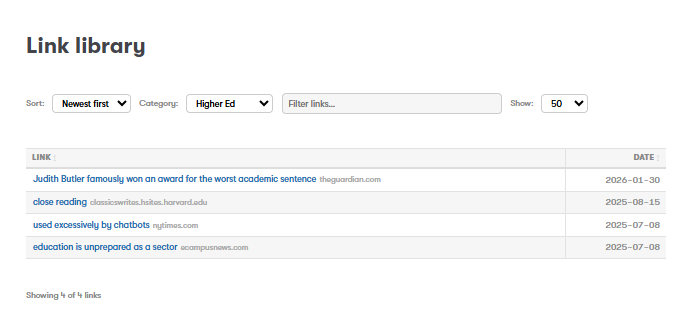
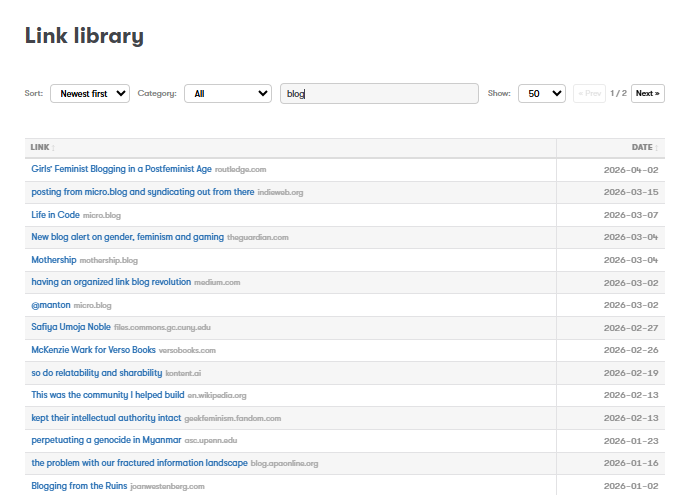
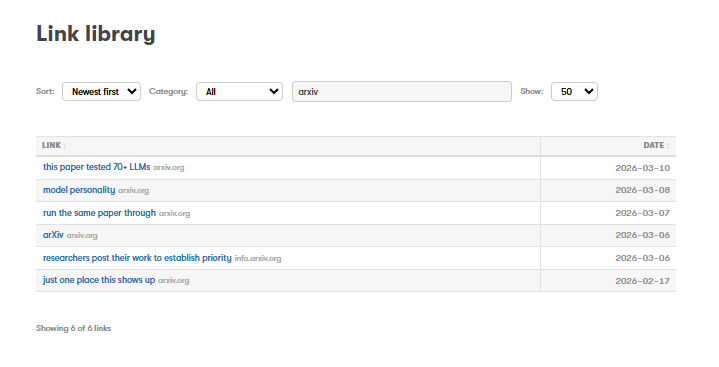
Testing a new feature I created using a mix of open source code and Claude, hoping I didn’t break my own site. I pulled together a dynamic link library using a Hugo partial and some shortcode that automatically catalogs all of my outbound links into sortable lists.

“Last mile” issues around AI in Harvard Business Review. Digital technologies work best in optimal environments, while most real world environments are nonoptimal and arguably non-optimizable.
An observation on feminist writing and Jezebel: Throughout history, a lot of time and energy has been spent mediating how and whether certain kinds of people talk to one another. The feminist blogosphere, for all its faults, was the first time lateral, public, unmediated conversation happened among women at scale. Many kinds of women were there that had no space at other tables. And it was very messy, and very revealing, because it was the first time that happened at scale for all to see.
Some thoughts:
Dip into the Diffusion Bias Explorer to explore how the text-to-image models like Stable Diffusion v1.4, Stable Diffusion v.2 and DALLE-2 represent different professions and adjectives.
What Midjourney (AI) thinks university leaders look like. Of course, the technology reflects old ideas about expertise and leadership, but AI adds the ability to reproduce these biases times infinity.
Another AI writing tell that annoys me is the preoccupation with describing what “exists,” and what is “structural” or “architectural” to an ephemeral idea. LLMs seem tuned to describing physical presence and connections even where they aren’t appropriate and don’t make sense.
A couple of weeks ago I had an interesting convo with Jessica Grose on Threads about the rise of the “Luddite teen” trend. I largely suspect neo-Luddism is a class-related trend and will not be durable. In short, I remain unconvinced that the concern of white collar professionals and parents about the attention economy can be universalized to everyone in the actual economy. This weekend, the NYT reports that the “one laptop per child” goal we’ve been living with in public education may be on the way out, like I hinted in that thread. As the anti-AI backlash develops in real time, it will implicate other tech trends like so.
I’ve been dismayed to find out how much schoolwork happens in Google Classroom in 2026, especially since the COVID shutdown accelerated the shift. My kiddo has received a good deal of math instruction through digital modules, and I’ve learned that if I want her experience to be different, I need to be prepared to pay out of pocket for a private tutor (a scenario taken for granted by much of the commentariat). At the same time, I learned that our local school district is struggling to keep up with the costs of all the hardware and software it committed to over the years, ostensibly for educational continuity, equity and access. Do we need the tech or not? Who decides what it means and how it’s applied? Chicken, egg.
I think it would be foolish to throw up our hands and say the kids need paper and pencil and nothing else, and yet that’s where the discourse is going. I have low confidence that our current landscape will produce a sane and reasonable solution to this tangle – even Haidt is selling you a product here. Until then, we need to consider what it means to offload the costs, accountability, and responsibility for this technology onto school districts, parents, and children, many of whom do not have the time, resources, or know-how to curate an ideal tech experience on nights and weekends.
This post is mostly an excuse to talk about my latest playlist: Digital Animal. This one consists of about 200 songs across genres, all reflecting on our human relationship to science and technology, futurism, digital culture and the internet.
When I’m chewing over a big idea, I like to compile resources in and around that idea to help support my thinking. Embracing my angst about artificial intelligence, I started compiling songs that reach back to the early 20th century, tapping into prior generations’ anxieties about telephones, television and early networking technology, adding more contemporary concerns as I went. The playlist runs from David Bowie and Blue Öyster Cult and Kraftwerk to Zapp and Radiohead, then forward into modern takes on social media, cell phones, and the internet from Missy Elliott, Gillian Welch and Charli XCX.
I like a playlist because it’s convenient, and because songs are one place where meaning and feeling are created simultaneously, and because it’s easy to spot salient patterns across disparate sources. Scholars in interdisciplinary studies have long argued that you cannot fully understand a thing without understanding what it feels like to live with it, and that cultural analysis may get you there faster than surveys will anyway. Meanwhile most writing about technology separates feelings from form and function. Art and music compress all three, and have the potential to surface ideas that professional and institutional language can’t. Art and culture frequently peg an issue down before emerging best practices are formalized in business and academia.
For anyone working in technology communications, that lag between culture and practice has practical consequences. The language we use to describe technical systems shapes what people can think and do about those systems. An institutional frame — efficiency, access, innovation, value — consistently misses important dynamics that people living inside those systems are experiencing as users and as people. Art keeps the human subject inside the frame, functioning as both anecdote and data.
Plus, it’s fun and we should collectively think about art as much as possible. So, treat every song like a portal.
What does it mean to be both digital and animal? Some observations:
Is fretting about our relationship to tech and industry part of the human condition? Or is there something specific to tech that accelerates these anxieties and impulses?
A few favs:
In which the author summarizes artificial intelligence functions that might be reasonably regulated.
A write up on sycophancy in popular chatbots.
The belief that LLMs are intelligent is based on the idea that language and intelligence are equivalent. From November, this article from The Verge argues that idea is a misnomer, instead arguing that we should think of language as a cultural tool we evolved to share our thoughts with one another.
On AI and the value of “taste” in Silicon Valley. As a pretentious hipster reformed, recalibrated, humbled, but spicy, I welcome the return of bad taste as a social dealbreaker. Except for when bad taste is good. 🌶️
More discussion on how “last mile” problems suggest that stories about massive AI disruption of jobs are hyperbole.
This writer suggests that LLMs used to be pretty cool and creative — read: exceedingly weird — and that corporate tinkering to prepare the tech for a broader market took away some of the magic.
The “stochastic parrot” argument against LLMs has some rhetorical limits.
Author Margaret Atwood plays with Claude and reports back on her experience.
Interesting read: NYT is using a custom LLM tool to track trends within the “manosphere,” as reported by the Nieman Journalism Lab.